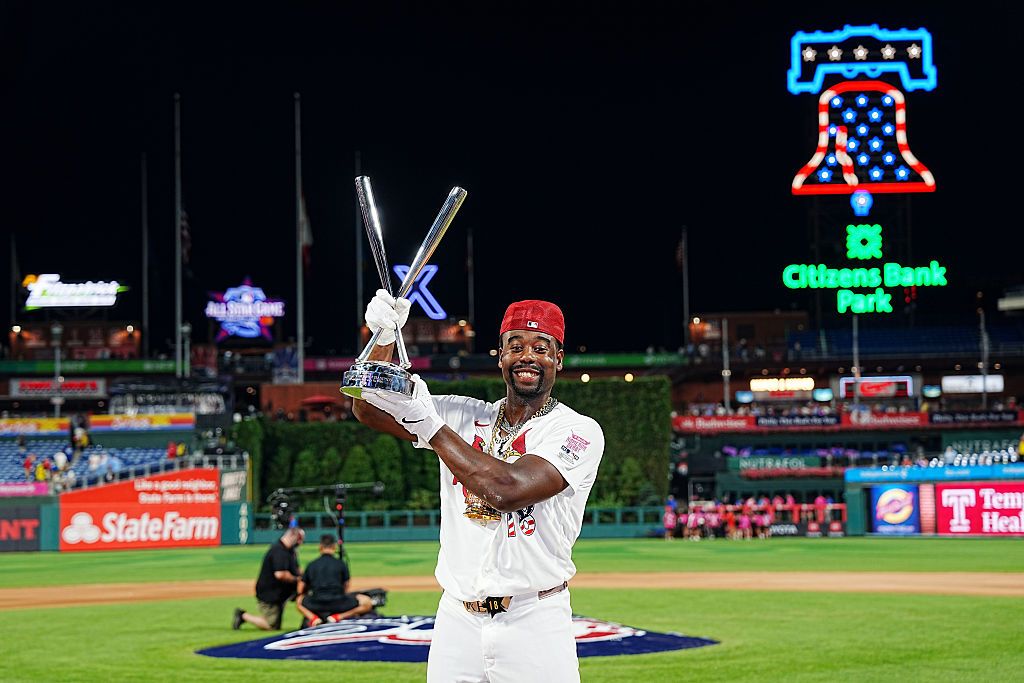
Jordan Walker entered Monday night’s Home Run Derby as one of the younger and less experienced names in the field. He left Citizens Bank Park as a champion — and possibly a new source of inspiration for Black children searching for someone who looks like them on baseball’s biggest stage. The 24-year-old St. Louis Cardinals star became the first player in franchise history to win the Derby, completing a dramatic run through a field loaded with established power hitters.
The final round could not have been scripted much better. Phillies slugger Kyle Schwarber had the Philadelphia crowd behind him as he launched 11 home runs, leaving Walker needing a late surge to steal the trophy. Walked responded by homering on each of his final six swings, including a walk-off blast that gave him a 12-11 victory. He finished the night with 31 total home runs and answered a hostile crowd by delivering one of the most clutch finishes in Derby history.
As meaningful as the trophy was, Walker’s comments afterward may have carried even more weight. He said he wants to become a role model for Black children and hopes moments like his Derby victory encourage more of them to view baseball as an option. That matters in a sport that has spent years trying to reconnect with Black communities and reverse the declining visibility of African American players at its highest level.
Every generation needs examples. Before young players can picture themselves performing under bright lights, they usually have to see somebody else do it first. Walker may now be that person for a child who watched him withstand the pressure, silence the Philadelphia crowd and celebrate on national television. At the same time, his path was likely influenced by the Black men who made baseball feel possible long before he picked up a bat.
The path was anything but easy. Black players helped build professional baseball through independent teams and the Negro leagues while the white major league deliberately excluded them. Moses Fleetwood Walker played for the Toledo Blue Stocking in 1884, but organized baseball’s color line kept openly Black players out of the American and National leagues for more than six decades afterward. The Negro Leagues became home to some of the greatest players the game has ever seen, even as racism denied many of them the money, exposure and recognition available to white stars.
Jackie Robinson finally shattered the modern color barrier when he debuted for the Brooklyn Dodgers on April 15, 1947. Larry Doby integrated the American League less than three months later, and both men endured racist insults, threats, isolation and discrimination simply for taking the field. Integration did not immediately eliminate those problems either. Black players continued to confront racism while becoming MVPs, World Series heroes, record holders, and some of the most recognizable athletes in American history.
Walker’s victory represents the newest chapter in that history. Here are 12 Black men whose talent, impact, style and cultural significance made them true icons of Major League Baseball.
Jackie Robinson
No Black player’s impact on Major League Baseball — or American society — is greater than Jackie Robinson’s. By integrating the Brooklyn Dodgers in 1947, Robinson carried the burden of performing at an elite level while facing relentless racism and pressure to avoid retaliating. He won Rookie of the Year, became the National League MVP in 1949, helped Brooklyn win the 1955 World Series and became a symbol of courage whose No. 42 is now retired throughout MLB.
Willie Mays
Willie Mays was baseball brilliance in its most complete form. “The Say Hey Kid” could hit for average, launch home runs, steal bases and change games with his glove and arm. His over-the-shoulder catch during the 1954 World Series became one of the defining images in sports history, while his combination of talent, joy and showmanship helped make him one of America’s first widely celebrated Black athletic superstars.
Hank Aaron
Hank Aaron’s pursuit of Babe Ruth’s career home-run record became a defining American story. Aaron endured racist hate mail and death threats as he approached the record, yet continued producing with remarkable consistency before hitting No. 715 on April 8, 1974. “Hammerin’ Hank” retired with 755 home runs and remains an enduring symbol of excellence, dignity and perseverance.
Ken Griffey Jr.
For an entire generation, Ken Griffey Jr. was the coolest player in baseball. The backward hat, effortless swing, wall-climbing catches and infectious smile made “The Kid” a cultural icon far beyond the sport. Griffey hit 630 career home runs, won 10 Golden Gloves and helped make baseball feel young, stylish and exciting during the 1990s without sacrificing the respect of traditional fans.
Satchel Paige
Satchel Paige was more than an elite pitcher. He was one of baseball’s first true attractions, drawing massive crowds throughout the Negro Leagues with his electric fastball, larger-than-life personality and unforgettable stories. Paige finally reached the majors in 1948, won a World Series with Cleveland and later became the oldest player to appear in an MLB game. His charisma and talent made him one of baseball’s greatest legends.
Barry Bonds
Barry Bonds’ complicated legacy cannot be separated from the steroid era, but neither can his place among baseball’s most iconic players. Bonds won a record seven MVP awards, became MLB’s all-time home-run leader with 762 and produced one of the most feared offensive careers the sport has ever seen. Whether celebrated or criticized, his impact on baseball remains impossible to ignore.
Josh Gibson
Josh Gibson never received a fair opportunity to display his greatness in the integrated major leagues, but his legend became too powerful for baseball history to ignore. The fearsome Homestead Grays catcher was one of the Negro leagues’ greatest power hitters and was often described as the “Black Babe Ruth” — although many who saw him play believed Ruth should have been called the white Josh Gibson. His statistics are now part of MLB’s official historical record, further validating what generations of Black baseball fans already understood about his greatness.
Rickey Henderson
Rickey Henderson did not merely steal bases — he turned them into theater. Baseball’s all-time leader in stolen bases and runs scored, combined with blazing speed, power, confidence and an unforgettable personality. Henderson could disrupt an entire game before the pitcher even threw a pitch, and his career record of 1,406 steals may be one of the safest in professional sports.
Bob Gibson
Bob Gibson didn’t just intimidate hitters — he redefined what dominance looked like on the mound. The Cardinals legend won two Cy Young Awards, two World Series titles, and the 1968 National League MVP. His microscopic 1.12 ERA in 1968 was so dominant that MLB lowered the pitcher’s mound the following season to help hitters. Fiercely competitive, Gibson became the gold standard for generations of power pitchers.
Reggie Jackson
Few players embraced the spotlight like Reggie Jackson/ His three-home-run performance in Game 6 of the 1977 World Series earned him the nickname “Mr. October” and cemented his place in Yankees lore. Jackson was outspoken, charismatic and unapologetically confident at a time when Black athletes were often expected to stay quiet, making him one of baseball’s first crossover superstars.
Frank Robinson
Frank Robinson was already one of baseball’s greatest sluggers before making history from the dugout. He remains the only player to win MVP awards in both the National and American leagues, to capture the Triple Crown in 1966, and to finish with 586 home runs. In 1975, Robinson became the first Black manager in modern MLB history, extending his influence well beyond his Hall of Fame playing career.
Larry Doby
Larry Doby’s place in baseball history is often overshadowed by Jackie Robinson’s, but his impact was just as groundbreaking. Just 11 weeks after Robinson integrated the National League, Doby became the first Black player in the American League when he debuted for the Cleveland Indians on July 5, 1947. He endured much of the same racist abuse while helping Cleveland win the 1948 World Series, later becoming a seven-time All-Star and MLB’s second Black manager. His resilience and excellence secured his place among baseball’s greatest pioneers.