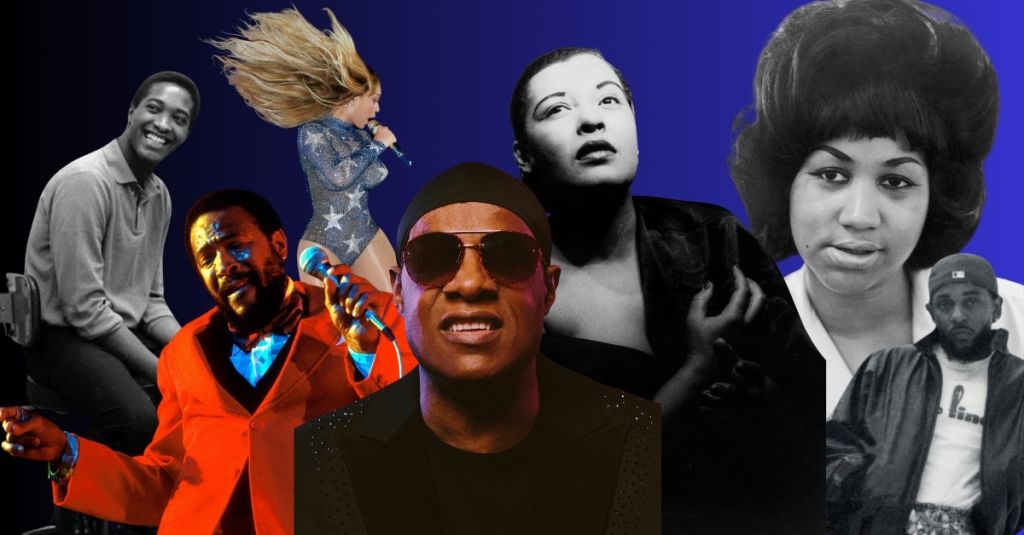
Black History Month: Music Inspired By Social Justice Movements
Black History Month: Music Inspired By The Social Justice Movement - Page 2
Throughout history, Black musicians have used their platform to capture the fullness of the Black experience. From songs of overcoming, joy, to sorrow, heartbreak and pain.
Black History Month: Music Inspired By The Social Justice Movement
Throughout history, Black musicians have used their platform to capture the fullness of the Black experience. From songs of overcoming, joy, to sorrow, heartbreak and pain.
Many of these songs have been anthems for the Civil Rights and social justice movements. Many of these innovators broke barriers with these songs, addressing violent acts of racism, police brutality, and lynching, all while expressing the hopefulness of change.
Because of this, several Black artists became political targets due to their music because of the influence it had on the masses. These songs exposed injustices in politics and reached enough audiences that several of their songs were illegal to perform or banned from radio and even television.
Love Black History Month? Get more! Join the Foxy 107.1-104.3 Newsletter
Thank you for subscribing! Please be sure to open and click your first newsletter so we can confirm your subscription.
For Black History Month, we highlight the songs that symphonied a movement, and the legendary musicians who took risks in their songs to address discrimination in the Black community.
A Change Is Gonna Come — Sam Cooke
Possibly the most recognizable anthem of the Civil Rights Movement, “A Change Is Gonna Come,” was inspired by several events in Sam Cooke’s life. Most notably, when the artist was refused a stay at a whites-only motel in Louisiana.
This event compelled him to write a song that spoke to the struggles of Black Americans at the time. It is considered one of Cooke’s most influential songs in his discography.
Mississippi G*ddam — Nina Simone
After the 16th Street Baptist Church bombing that killed four Black girls, the murder of Emmett Till, “Mississippi G*ddam” became pianist and singer Nina Simone’s first political anthem. It is reported that the song was written in an hour in a rush of “fury, hatred, and determination.”
Simone incorporates several political references in the song early on, with the lyrics, “Alabama’s got me so upset, Tennessee’s made me lose my rest, and everybody knows about Mississippi g*ddam.”
Say It Loud – I’m Black and I’m Proud — James Brown
A song of affirmation for the Black community, “Say It Loud – I’m Black and I’m Proud” was released in 1968 by the King of Soul James Brown. It was recorded in LA with 30 young kids from urban neighborhoods.
Strange Fruit — Billie Holiday
“Strange Fruit” is a powerful anti-lynching protest song that was released in 1939. It made jazz artist Billie Holiday the target of the Federal Bureau of Narcotics and agents ordered her to stop performing the song, which she refused.
This led to several years of targeting and harassment from federal agents and law enforcement authorities, including on her deathbed.
Respect — Aretha Franklin
Written by Otis Redding, this 1965 soul hit, sung by the legendary Aretha Franklin, became an anthem for the feminist movement in the 1970s.
What’s Going On — Marvin Gaye
Marvin Gaye’s “What’s Going On” addresses poverty, civil unrest and police brutality in the early 1970s. The song urges compassion and unity.
You Haven’t Done Nothing — Stevie Wonder
This 1974 funk song by Stevie Wonder is a political statement at former President Richard Nixon. It was considered a powerful song that pointed directly at the subject. The song also featured background “doo-wops” by The Jackson Five.
The lyrics held a repitive message and catchy hook, chanting, “But we are sick and tired of hearing your song/Tellin’ how you are gonna change right from wrong/’Cause if you really want to hear our views/You haven’t done nothin'”
Someday We’ll All Be Free — Donny Hathaway
This 1973 hit was originally written for Donny Hathaway about the mental pain he was experiencing as a diagnosed paranoid schizophrenic. Throughout the years, “Someday We’ll All Be Free” took a deeper meaning for Black Americans suffering systemic inequality.
They Don’t Care About Us — Michael Jackson
Michael Jackson’s “They Don’t Care About Us” is a powerful protest anthem that addresses police brutality, racial discrimination and the plight of oppressed minorities. It also highlighted systemic issues such as poverty and class.
Though many people are familiar with the Rio de Janeiro version of the music video, Spike Lee directed a second version with Jackson performing alongside prison inmates, handcuffed and uncensored footage of the brutality against Rodney King, LA riots and imagery of the KKK. Due to this, that version was banned from primetime airing on music video networks.
Formation — Béyonce Ft. Kendrick Lamar
The music video for “Formation” by Béyonce sparked intense controversy by addressing police brutality, systemic racism against Black people, Hurricane Katrina and the Black Lives Movement and resulted in a charged performance at the Super Bowl 50 Halftime Show. This resulted in police unions calling for boycotts of the artist.
Alright — Kendrick Lamar
Rapper Kendrick Lamar song turned protest chant “Alright” highlights police brutality, the Black Lives Matter movement, and systemic oppression marginalized groups face.
The 2015 video sparked major controversy for it’s portrayal of police brutality and it’s lyrics “And we hate po-po/ Wanna kill us dead in the street, fo sho.”